
Free resource
Employee benefits survey questions
The categories worth covering, example questions for each, and how to word them so the answers are actually comparable across employers.
174
Questions in the benefits template
7
Benefit categories covered
45+
Health plan and cost data points
Benefits questions fail differently than wage questions
Wage questions are about levels: what a job pays. Benefits questions are about prevalence and design: which plans an employer offers, how much of the premium it covers, how time off accrues, how a retirement match is structured. That difference changes how you write them.
The recurring mistake is asking for benefits in free text. “Describe your health plan” produces a column of prose that cannot be aggregated into anything. Structured formats are what make a benefits section reportable, and they are also faster for the respondent, which protects your completion rate.
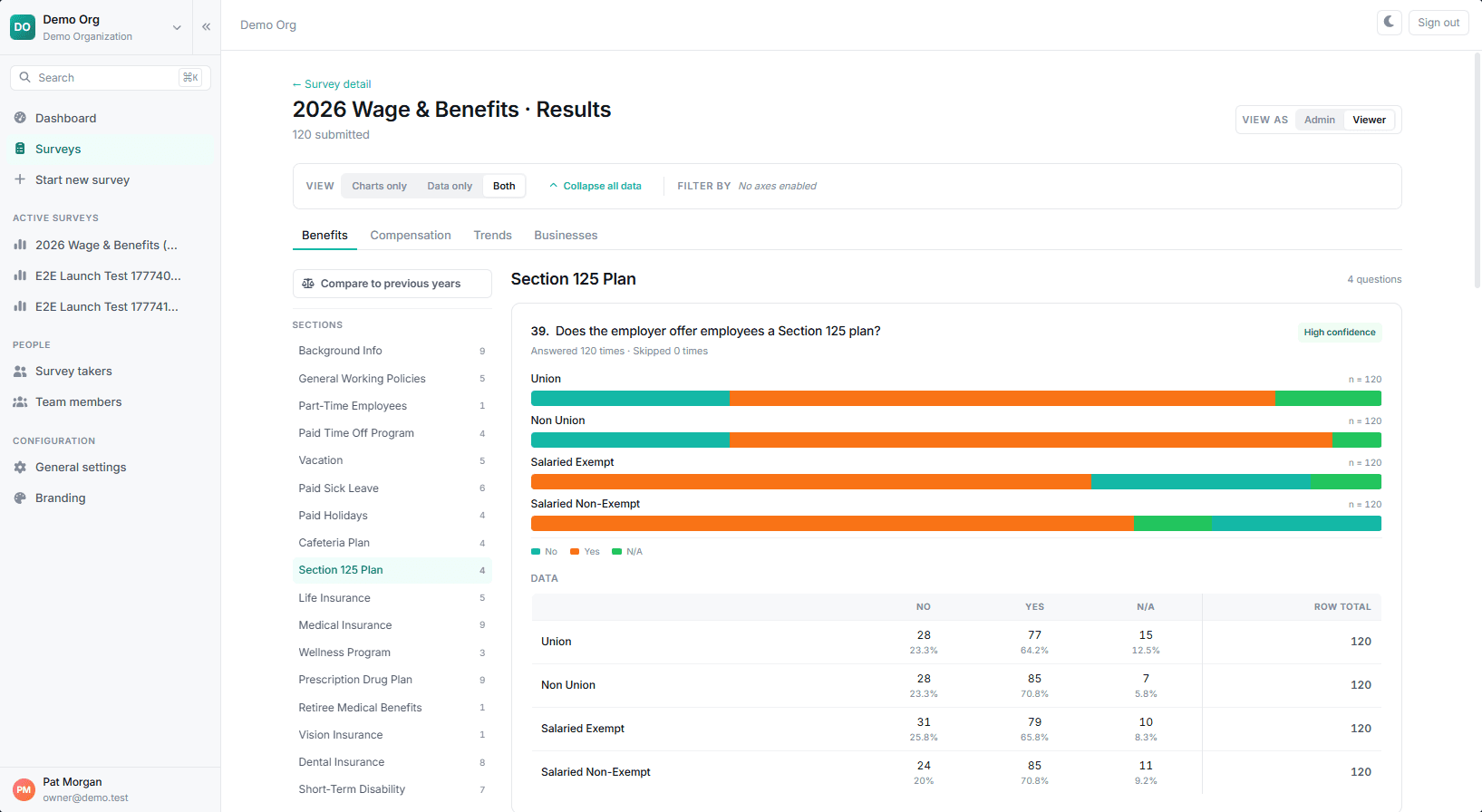
The categories to cover
Our default benefits instrument runs to 174 questions across these areas. Most programs use a subset. Start from the full list and remove what does not apply rather than building up from nothing, because the omissions are what you notice after results publish.
- Medical, dental, vision, and pharmacy. Plan types and funding method, employee versus family tiers, the employer contribution percentage, deductible and out-of-pocket bands, and whether an HSA or HRA is offered with an employer contribution.
- Health plan cost and trend. The renewal increase, the expected change next year, and which cost-containment moves an employer has made. This is the part most benefits surveys skip and participants most want.
- Retirement and financial wellness. Plan type, match formula, vesting, and whether loans, hardship withdrawals, and rollovers are allowed. The match formula matters more than the headline percentage.
- Paid time off. Accrual rate by tenure band, whether vacation and sick are combined, carryover and payout rules, and the paid holiday count.
- Leave. Parental leave beyond the statutory minimum, whether it covers adoptive and foster parents, dependent care benefits, and medical and bereavement leave.
- Life and disability. Coverage multiple, short and long-term disability, and how much of the premium the employee carries.
- Wellness, mental health, and telehealth. Assistance program access, which mental health services are covered, telehealth options, and how many employees actually use them.
- Development. Tuition and certification reimbursement by level, and, where it fits the sector, apprenticeship or loan-repayment support.
- Work and pay policies. Shift differentials, flex time, remote and hybrid arrangements including days per week, drug and marijuana testing, and any employee ownership or equity program.
What is inside each category
The instrument runs deeper than the headline categories. Here is everything it asks about, without the exact wording.
50 topics.
Health and welfare
10 topics
- Plan types offered
- Funding method (fully insured, level funded, self funded)
- Carrier and pharmacy benefit manager
- Employer premium contribution by tier
- Deductibles and out-of-pocket maximums
- Co-pays and prescription tiers
- HSA and HRA with employer contribution
- Part-time eligibility and waiting period
- Renewal increase and cost containment
- Dependent coverage and affordability
Retirement and financial wellness
7 topics
- Plan type
- Match formula
- Vesting schedule
- Loans and hardship withdrawals
- In-service withdrawals and rollovers
- Financial wellness programs
- Succession and phased retirement
Paid time off
8 topics
- Accrual by tenure
- Vacation and sick, combined or separate
- Carryover and payout
- Paid holiday count
- Additional and religious holidays
- Holiday pay provisions
- Bereavement
- Sabbatical
Leave
6 topics
- Parental leave duration
- Adoptive and foster coverage
- Dependent care benefits
- Medical leave
- Extended leave of absence
- Unpaid leave provisions
Life and disability
4 topics
- Life coverage multiple
- Short-term disability
- Long-term disability
- Employee premium share
Wellness and development
6 topics
- Employee assistance program
- Mental health services covered
- Telehealth options and utilization
- Chronic disease management
- Tuition and certification reimbursement
- Wellness program design and participation
Work and pay policies
9 topics
- Shift differentials
- Flex time and formal policy
- Remote and hybrid, days per week
- Job sharing
- Dress code
- Drug and marijuana testing
- Mileage and severance
- Employee ownership and equity
- Non-monetary incentives and awards
Example questions from the template
A page about questions should show some. These are real questions from the template, from a one-click yes or no to a multi-select grid that captures a benefit across every employee class at once. What they share: each one resolves to a selection, a rate, or a number, which is what lets the answers aggregate.
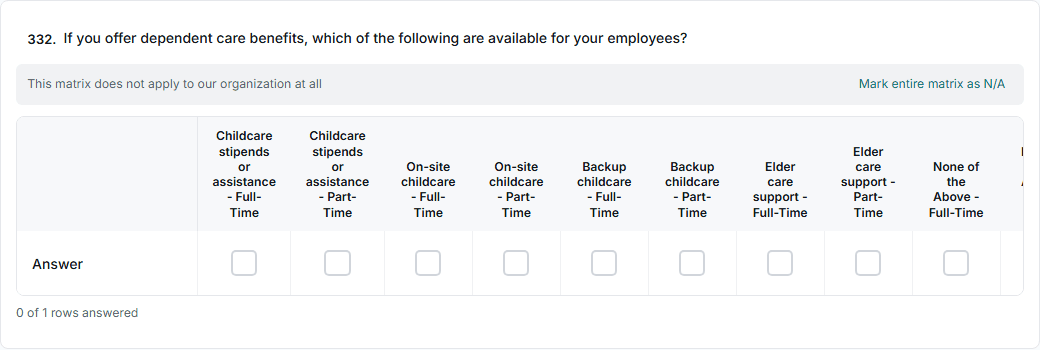
One benefit, asked across full-time and part-time at once. Every cell is a checkbox, so the answer aggregates into a prevalence rate for each group instead of a paragraph you cannot chart.
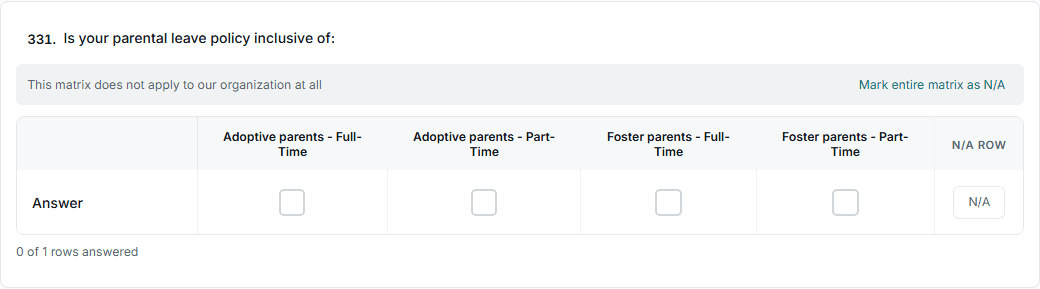
Full-time and part-time in the same grid. One question produces four comparable data points, and the taker still only sees one row of checkboxes.
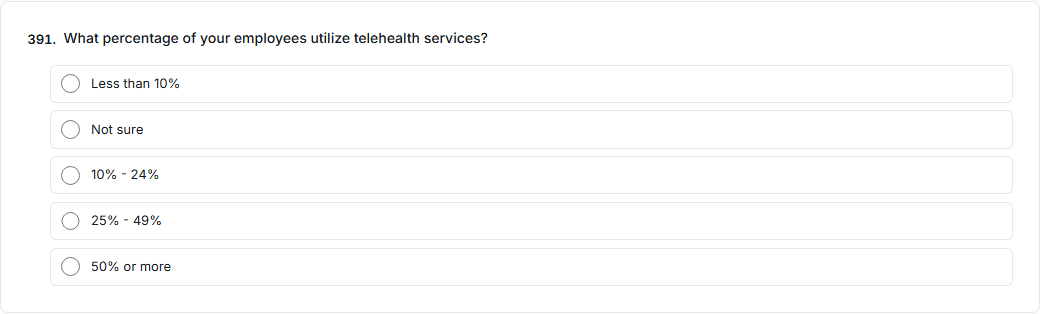
A percentage band, not a free-text guess. Bands aggregate cleanly; open numbers scattered across employers do not.

The simplest structured format. Prevalence in one click, and the completion rate thanks you for it.
Questions that look fine and wreck your data
Each of these gets written into benefits surveys constantly. Each produces a column you cannot report.
Avoid
"Describe your health plan."
Free text cannot be aggregated. You get a column of prose and no chart. Ask for plan type, funding method, and contribution as separate structured fields.
Avoid
"What benefits do you offer?" asked once.
One employer often runs several packages. A single question returns whichever group the respondent thought of first. Split every benefit by employee class.
Avoid
"Do you offer competitive benefits?"
This measures self-image, not benefits. Competitive against whom? Ask what is offered and let the aggregate decide what competitive means.
Avoid
A plan question with no effective date.
Plan years do not line up across employers. Without a date you cannot tell whether two answers describe the same period, and your trend line becomes noise.
Avoid
"How generous is your PTO?" on a 1 to 5 scale.
A rating is not a benchmark. Ask for accrual days by tenure band. Numbers compare across employers; opinions do not.
The full instrument is 174 questions, already structured
Start from the complete benefits template and cut what you do not need. Free, usually the same business day, no sales call attached.
What your questions become
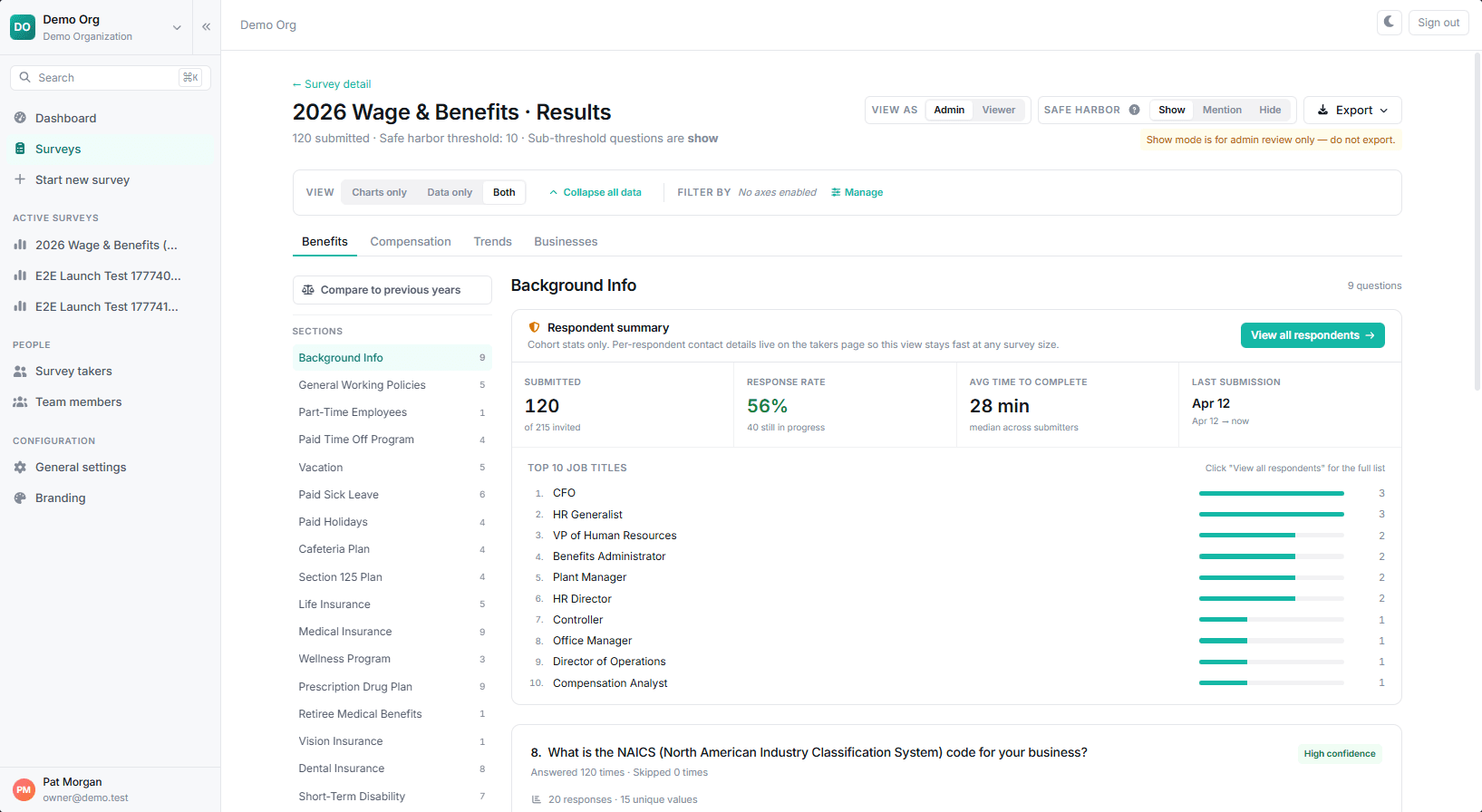
Wage questions produce percentiles. Benefits questions produce prevalence and design: the share of employers offering a benefit, the median employer premium contribution, PTO by tenure, the spread of retirement match formulas.
Structured answers are what let the platform turn a benefits section into charts your members actually read, broken out by employee class and, if you run it again next year, tracked against the prior cycle. The question format you choose at the start is what decides whether that report exists at the end.
Employers only answer benefits questions they trust
Benefits and cost data are sensitive, and a survey that feels exposing gets abandoned or answered vaguely. Every result on the platform is aggregated, and safe-harbor suppression hides any figure that too few employers answered, with the threshold set to fit your cohort. Say that up front in your invitation. It is the difference between a premium-contribution question that gets a real number and one that gets skipped.
It also sets an honest expectation. A small group loses some detail, and it is better to decide which detail you are willing to lose before launch than to find a redacted cell in the published report.
Add the questions your sector cares about
Start from the full list, then add what your industry actually benchmarks.
Manufacturing
Add shift differentials, safety incentives, and apprenticeship support. The skilled-trades package is usually the story.
See the survey guide →
Healthcare
Add shift and weekend differentials, certification pay, and loan repayment. Retention data is what the board asks for.
See the survey guide →
Nonprofit
Add sabbatical policy, PTO depth, and retirement match, where cash is tight and total rewards carry the offer.
See the survey guide →
Writing questions that stay comparable
Step 1
Ask for structure, not description
Every question should resolve to a selection, a number, or a rate. If an answer could be a paragraph, the question needs rewriting before it goes out.
Step 2
Split by employee class
One employer often runs several packages. Asking a single question about your benefits produces an answer that describes whichever group the respondent thought of first.
Step 3
Pilot with three to five respondents
Send it to a handful of participants before launch and ask where they hesitated. Hesitation marks ambiguity, and ambiguity is what produces non-comparable answers at scale.
Step 4
Keep the wording stable year over year
Changing a question changes the trend line. If you must revise, note it in the report so next year nobody reads a wording change as a market movement.
Common questions
How teams think about benefits question design before they field a survey.
How many benefits questions is enough?
Enough to answer the decisions your members face, and no more. The template is 174 so you can cut, not so you send all of it. A shorter instrument finishes at a higher rate, and completion is what determines whether anything publishes.How do you keep benefits answers comparable across employers?
Three habits. Ask for a selection, a rate, or a number rather than free text. Split every answer by employee class. And stamp each plan answer with an effective date so you know you are comparing the same period.How is confidentiality protected?
Results are aggregated, and safe-harbor suppression hides any figure that too few employers answered, with the threshold set to fit your cohort. No individual company benefits or cost figure is shown.Should wages and benefits be one survey or two?
Usually two sections in one instrument. Wages are about levels and benefits are about prevalence and design, so they are written and reported differently. Mixing them without saying so is a common way a survey confuses its readers.Can we compare benefits year over year?
Yes, if the wording stays stable. Changing a question changes the trend line, so keep the phrasing fixed across cycles and note any revision in the report. Returning respondents see their prior-cycle answers pre-filled in the new form, so they can confirm what still holds or update what changed instead of starting from scratch. The prior-cycle submission stays locked; the pre-fill only seeds this cycle.Can we tailor the template to our industry?
Yes. Start from the full list, delete what does not apply, and add the items your sector benchmarks, like apprenticeship support in manufacturing or loan repayment in healthcare.
Benefits survey terms, defined
- Funding method
- Whether a health plan is fully insured, level funded, or self funded. It changes how the cost questions should be asked.
- PBM
- Pharmacy benefit manager, the company that administers prescription drug coverage inside a health plan.
- HSA and HRA
- Tax-advantaged accounts paired with certain health plans. Track whether the employer contributes and how much.
- Vesting
- How long an employee must stay before they own the employer contribution to their retirement plan.
- Employee class
- A group with its own package, such as union, non-union, salaried exempt, or salaried non-exempt.
- Safe harbor
- Suppression of any result too few employers answered, so no single company can be identified from the report.
Keep reading
Benefits survey template
The full instrument built from these categories, ready to edit for your organization.
How to run a wage and benefits survey
The complete methodology, including why wages and benefits usually belong in separate sections.
Salary benchmarking template
The wage side: occupation by career level, with percentile bands in each cell.
Complex surveys to send and don’t know where to start?
Book a 20-minute demo. We’ll show you the system, talk through your goals, and tell you whether we’re a fit. No pressure.