
Industry survey
Healthcare compensation survey
Benchmark nursing, clinical, and administrative pay across the employers in your association or network, all competing for the same clinicians.
What a healthcare compensation survey has to get right
A healthcare compensation survey collects pay, differential, and benefits data from providers in a region so each participant can see where it sits. HR teams in this sector usually ask for a healthcare salary survey; same instrument, and the word choice matters only in the invitation. Hospital systems, rural health networks, and state or regional associations are the usual sponsors.
The trap in healthcare is specialty. Registered nurse is not one job. An ICU nurse, an OR nurse, and a med-surg nurse clear at different rates, and a survey that reports a single RN median describes nobody. But the more finely you cut by specialty, the faster each cell runs into confidentiality limits. Designing around that tension is most of the work.
What it measures
Inside a healthcare compensation survey
Clinical roles, with specialty
Every SOC occupation is available; a healthcare survey leans hardest on registered nurses (29-1141), licensed practical nurses (29-2061), physical therapists (29-1123), respiratory therapists (29-1126), medical records specialists (29-2072), plus nurse management and clinical operations. Specialty is captured alongside the SOC code, because it moves the number.
- Specialty captured as a reportable dimension
- Prebuilt professional and management ladders
- Custom roles for organization-specific titles
Differentials and premium pay
In healthcare the differential structure often decides where a clinician works. The instrument separates each component so participants can compare the actual offer, not just the base.
- Night, weekend, and on-call differentials
- Call-back and per diem rates
- Sign-on and retention bonus practice
Benefits and retention
Start from the 174-question benefits template and extend it with the items clinicians actually weigh when deciding whether to stay.
- Certification and continuing education support
- Loan repayment and tuition programs
- Turnover, tenure, and fill difficulty by role

Why a regional cut beats a national benchmark
Clinical labor markets are regional, and the pressure varies sharply from one market to the next. A national median tells a rural critical-access hospital very little about the system forty miles away that is actively recruiting its nurses.
Travel and agency rates make this worse. When agency pay resets the local expectation, the only way to know what your permanent staff are comparing themselves against is to survey the employers in your actual catchment.
Confidentiality
Specialty detail versus confidentiality, resolved
Healthcare surveys hit the hardest version of the small-cell problem. Cut RN pay by specialty, shift, and facility and you can reach a cell containing exactly one person. In a rural market with a single hospital, some roles are identifying by definition.
The answer is not to publish less detail everywhere. It is to protect at the cell level so the detailed cuts that are safe still publish, and only the thin ones are withheld.
- Per-occupation cell protection. A specialty reported by too few employers is hidden independently, even when the overall nursing question clears the threshold.
- Configurable threshold per survey. Set the minimum distinct-employer count that fits your market rather than accepting a fixed rule.
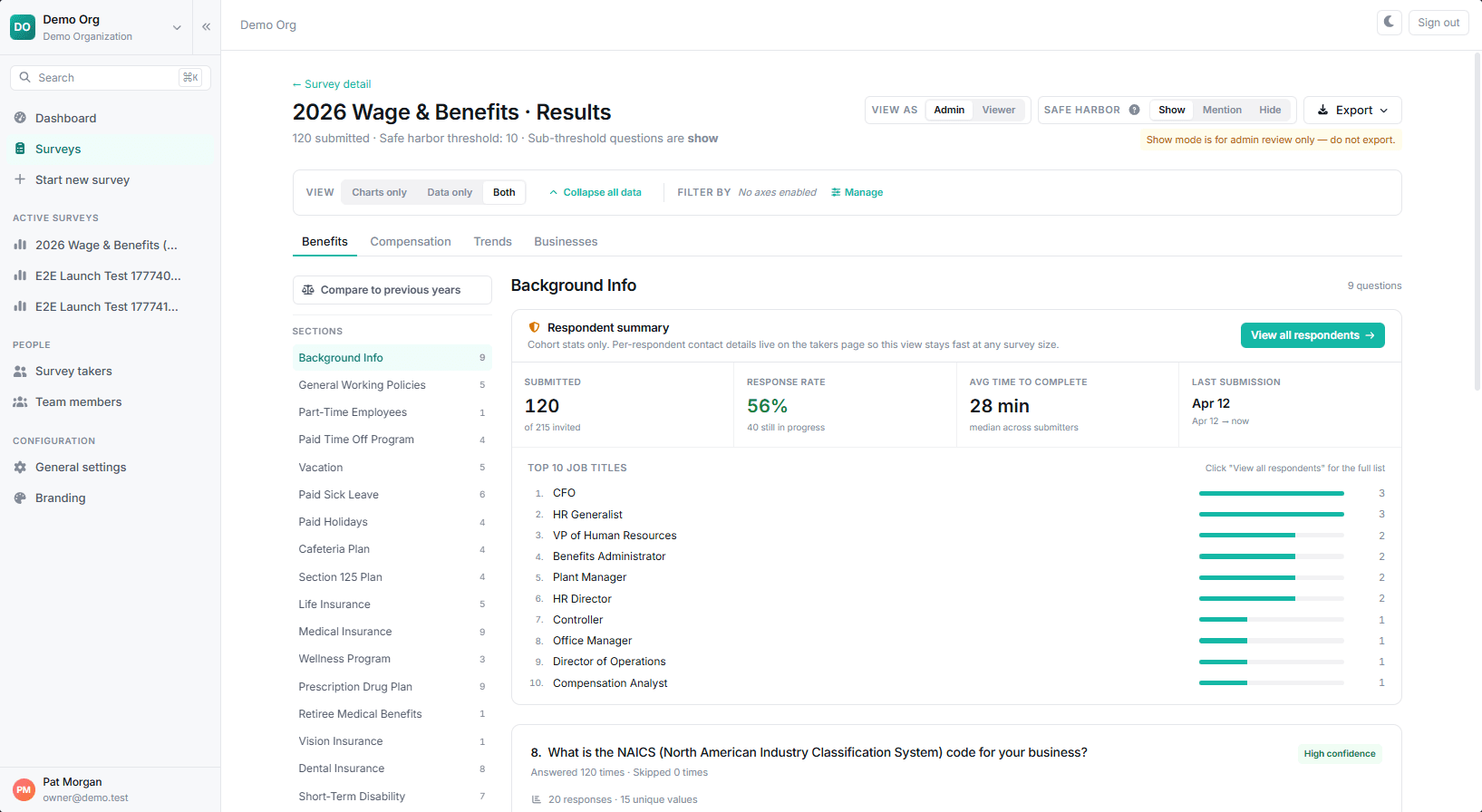
- Filtered views stay protected. Readers can combine filters however they like; any result below the Safe Harbor threshold is suppressed in that filtered view as well, so filtering can never isolate a single employer.
- Consent-gated free text. Open-ended comments only appear in results when the respondent agrees to share them.
How to run one
The full methodology lives in our complete wage and benefits survey guide. These are the steps that differ for this industry.
Step 1
Decide your specialty granularity up front
List the specialties you need before fielding, then check each against your suppression threshold. It is better to combine two specialties deliberately at design time than to publish a report full of redacted cells.
Step 2
Collect the differential structure, not just the rate
Ask what each shift and on-call arrangement pays and how call-back is treated. A base-only benchmark will understate what a competing employer is actually offering.
Step 3
Separate permanent from contingent
Blending travel and agency rates into permanent staff figures produces a median that describes neither. Capture them as distinct populations so both are readable.
Step 4
Field it on a cycle that matches budget season
Compensation decisions in healthcare cluster around budget approval. Field early enough that results land before the committee meets, not after.
Common questions
Can we report by specialty without exposing individual employers?
Yes. Per-occupation cell protection hides any specialty reported by too few employers while leaving the rest of the report intact. As part of a planning add-on or a Done-For-You engagement, we can talk through which specialties are likely to clear Safe Harbor before you field.
How do we handle travel and agency rates?
Capture them separately from permanent staff. Blending the two produces a median that describes neither population. Keeping them distinct also lets you show the gap, which is often the most useful chart in the report.
Who sees the results, and when?
You decide. Results compile automatically when the survey closes, then wait on your release. You can release to participants, internal viewers, and external subscribers on separate schedules, and revoke access just as easily.
Do participants have to re-enter everything each year?
No. Returning respondents are matched to their prior-year records and their answers pre-fill, so they review and update rather than starting from a blank form.
Keep reading
How to run a wage and benefits survey
The complete methodology, from writing comparable questions through publishing results that hold up.
Employee benefits survey questions
The benefit categories to cover and how to word them, drawn from our 174-question template.
Reading your survey results
How to structure the report, read percentiles, and spot the outliers that should not drive a pay decision.
Complex surveys to send and don’t know where to start?
Book a 20-minute demo. We’ll show you the system, talk through your goals, and tell you whether we’re a fit. No pressure.