
Industry survey
Nonprofit compensation survey
Benchmark program, development, finance, and leadership pay across your member organizations, with data their boards will accept.
What a nonprofit compensation survey has to get right
A nonprofit compensation survey collects pay and benefits data from peer organizations so each participant can benchmark roles that rarely map cleanly onto commercial job titles. Foundations, associations, and united funds typically sponsor them on behalf of a sector or region.
The defining problem is comparability. Nonprofit titles are elastic: a program director at a two-person organization and a program director at a two-hundred-person organization share a title and nothing else. If you benchmark on title, you produce a number the board will correctly refuse to act on.
What it measures
Inside a nonprofit compensation survey
Roles defined by function
Executive leadership, program delivery, development and fundraising, finance and operations, communications, and direct service. Function plus scope is what makes these comparable, so the instrument captures both rather than relying on title.
- Organization budget band and headcount as context
- Reporting level captured per role
- Custom roles where the sector has no standard equivalent
Total compensation, not just salary
Nonprofits trade base pay against benefits and flexibility more than most sectors. A salary-only benchmark systematically misreads who is actually competitive.
- Base salary and any bonus or stipend practice
- Employer benefit contribution by tier
- Cost-of-living and equity adjustment practice
Benefits and equity data
The 174-question benefits template covers the standard categories, and you can add the demographic dimensions that make an internal equity review possible.
- Retirement match and vesting practice
- PTO, sabbatical, and flexible schedule policy
- Tenure and turnover by role

Why the peer set matters more than the sample size
For nonprofits the relevant market is usually a combination of mission area and geography, not one or the other. A regional arts organization competes for a development director against other arts organizations nearby, and against every other nonprofit in town that needs the same skill.
Getting the peer definition right at design time matters more here than adding respondents. A larger survey built on the wrong cohort produces a confident number that answers the wrong question.
Confidentiality
Public filings do not make the rest of your payroll public
Nonprofits carry an unusual disclosure profile. Top compensated positions already appear in public filings, which sometimes leads sponsors to assume confidentiality is less of a concern. The opposite is true: because part of the picture is public, an unprotected survey makes it easier to infer the part that is not.
Participants notice this. Suppression that is visible and explained is often what convinces a small organization to submit real numbers rather than rounded ones.
- Automatic low-count suppression. Any question answered by fewer than N distinct organizations is redacted, with N set per survey.
- Per-occupation cell protection. A role held by too few organizations is hidden on its own, which matters when one participant is much larger than the rest.
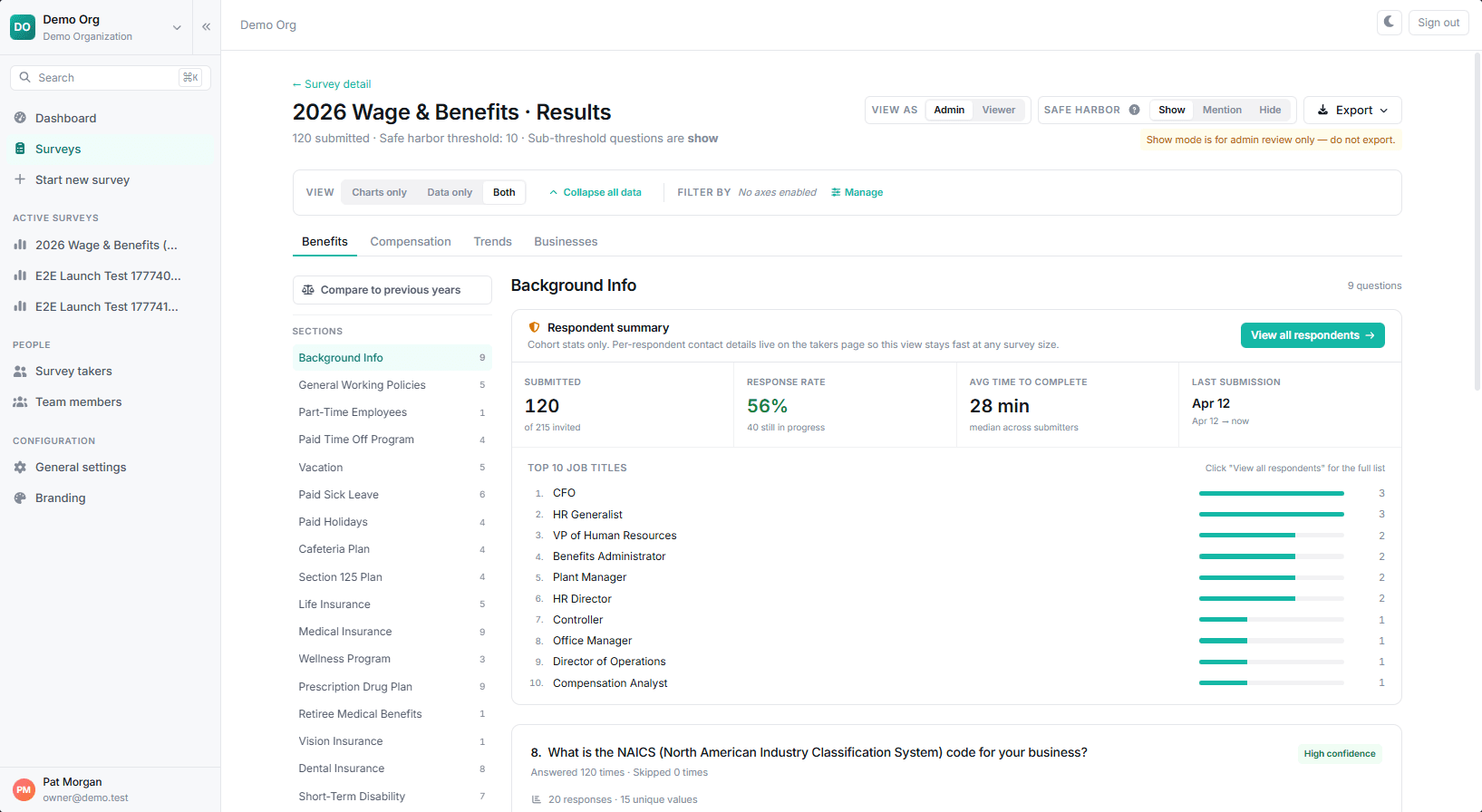
- Suppression on every slice. Combine budget band, mission area, or any other filter; results below the Safe Harbor threshold are suppressed in that view too, so no combination reaches a single organization.
- Exclude a question or a response. Remove a sensitive question or an outlier submission from published results with one click.
How to run one
The full methodology lives in our complete wage and benefits survey guide. These are the steps that differ for this industry.
Step 1
Define roles by function and scope
Write short role definitions describing the work and the reporting level, then ask participants to match against those rather than submitting titles. This single choice does more for comparability than any later analysis.
Step 2
Capture organization size as a filter axis
Budget band and headcount are what let a reader find comparable organizations, so designate them as filter axes at design time. Safe Harbor suppression protects any slice that gets too small.
Step 3
Ask for total compensation
Collect employer benefit contribution alongside salary. Two organizations with identical salaries and very different benefit loads are not paying the same, and boards ask about exactly this.
Step 4
Build the board view before you field
Decide what your member organizations need to take back to their boards, then confirm the instrument can produce it. It is far cheaper to add a question now than to explain a gap after results publish.
Common questions
How do we compare roles when nobody uses the same job titles?
Benchmark on function and scope rather than title. The survey asks participants to match against short role definitions, with organization budget band and headcount captured as context. That is what makes a program director at one organization comparable to a program director at another.
Can we use this for an internal pay equity review?
Yes, if you design for it. Capturing tenure, level, and the demographic dimensions you intend to analyze has to happen at instrument design, not afterward. This is a good candidate for the Ph.D. methodology review, since an equity analysis is only as defensible as the questions underneath it.
Our participants are small. Will anything actually publish?
It depends on how many organizations answer each question, not on how large they are. As part of a planning add-on or a Done-For-You engagement, we can talk through which roles are likely to clear the suppression threshold, and adjust the role list while it is still cheap to do so. See pricing for how the add-ons work.
What does it cost to run one?
The software-only license is a flat annual fee that includes up to three surveys a year for your members. Done-For-You is quoted per survey based on audience size. See pricing for the detail.
Keep reading
How to run a wage and benefits survey
The complete methodology, including how to define comparable jobs before you write a single question.
Employee benefits survey template
A customizable benefits instrument covering medical, retirement, PTO, leave, and professional development.
Surveys for HR teams and associations
How associations run member-wide benchmarking studies that individual members could not assemble alone.
Complex surveys to send and don’t know where to start?
Book a 20-minute demo. We’ll show you the system, talk through your goals, and tell you whether we’re a fit. No pressure.