Skip to content

Comparison

Compensation survey companies, compared honestly

Five different kinds of provider sell compensation data, and they are not interchangeable. What each one actually is, roughly what it costs, and when each is the right call, including when it is not us.

The five kinds of provider

Compensation survey companies fall into five categories: national syndicated data houses, industry firms that run their own participate-to-license surveys, real-time benchmarking tools, general-purpose survey builders, and consultants who run custom studies. They differ on the one axis that matters most: whether you are buying someone else’s dataset, or collecting data from the cohort you actually compete with.

Sensible Surveys is in the second camp: a platform for running your own wage and benefits survey on your own cohort, yourself or with our team running it. That is the lens of this page, and it is genuinely not the right answer for everyone, which the profiles below try to be honest about.

Provider by provider

What each one is, and when to pick it

Provider details reflect publicly listed offerings as of 2026; check their sites for the latest.

National syndicated data houses

Mercer, WTW (Willis Towers Watson)

Massive recurring datasets built from thousands of participating employers, sold as data licenses with their own job catalogues and level frameworks. The default choice of large enterprises, and the benchmark most comp consultants quote from.

Cost shape: Quoted per dataset and cut. Broad licenses run well into five figures, and metro-level or industry cuts are typically priced as add-ons.

Choose them when

You are a large employer competing nationally for broadly held corporate roles, you have a comp team that can do the job mapping, and you need data your auditors and board already recognize.

Choose us when

Your market is a county, a metro, or a specific industry cohort. The employers you lose people to are not the national panel, and no amount of national precision substitutes for asking them directly.


Read the full Mercer comparison

Participate-to-license industry surveys

Culpepper

Firms that run their own recurring industry surveys (technology, life sciences, professional services) and license the results. You submit your data to participate, then buy access, customized by the job functions and countries you need.

Cost shape: Annual data license, discounted for participants. Scope drives the price.

Choose them when

Your industry is one they cover deeply, your roles map cleanly to their catalogue, and you want validated data without running anything yourself.

Choose us when

You want a survey of YOUR cohort rather than their panel: your region, your members, your role definitions. They run their surveys; they do not run yours.

Read the full Culpepper comparison

Real-time benchmarking tools

Payscale, Ravio, Pave

Software platforms that aggregate compensation data continuously, often from connected HR systems, and sell dashboard access. Fresher than annual surveys, strongest in tech and other fast-moving national labor markets.

Cost shape: Software subscriptions, typically priced by company size.

Choose them when

You are hiring in a national talent market where rates move quarterly, and you mainly need offer-level guidance for individual roles.

Choose us when

You need a defensible regional or industry benchmark that a board, a council, or a room full of member companies will accept, with a stated cohort and methodology behind every number.

General-purpose survey builders

SurveyMonkey, Typeform, Alchemer

Form tools. Excellent at asking questions, with no compensation instruments, no occupation coding, no suppression rules, and no year-over-year machinery. The survey design, the confidentiality math, and all of the analysis are on you.

Cost shape: Per-seat subscriptions, from tens of dollars a month.

Choose them when

You need a quick general survey, or you have a statistician in-house and genuinely want to build the compensation instrument yourself.

Choose us when

The instrument is the hard part. Wage grids, SOC coding, safe-harbor suppression, and trend linking are exactly the pieces a form tool leaves you to invent.

Compensation consultants

Regional and national HR consulting firms

A firm designs and runs a custom study for you, one engagement at a time. Quality tracks the individual consultant, and the instrument usually leaves with them when the engagement ends.

Cost shape: Project-based. The typical range we see quoted for a full custom study is $20k to $80k per cycle.

Choose them when

You need heavy customization plus organizational consulting around the data, and budget is not the constraint.

Choose us when

You want the survey itself at a fraction of that, with the instrument, the roster, and the history staying yours, so year two does not start from zero. If you want hands off, our Done-For-You tier is the same idea at a different price point.

Side by side

The whole market in one table

Same five categories, scored on the questions buyers actually ask. Where another category is genuinely stronger, the table says so.

 Sensible SurveysSyndicated (Mercer, WTW)Industry surveys (Culpepper)Real-time toolsDIY survey buildersConsultants
Fit
Built forRegional and industry cohortsLarge national enterprisesTheir covered industriesFast national talent marketsQuick generic surveysHeavy custom engagements
Whose data you getYour own cohortTheir national panelTheir industry panelAggregated feedsWhatever you collectYour cohort
County and regional cutsMetro cuts as paid add-onsLimitedIf you build them
Capabilities
Compensation instruments (wage grids, SOC codes)n/a, data productn/a, data productn/a, data productVaries by firm
Safe-harbor suppression built inn/aDepends on consultant
Run it yourself: purpose-built survey softwareDashboards onlyGeneric forms only
Done-for-you surveys on your cohortIncluded tier, Ph.D.-reviewedTheir own surveys only
Year-over-year linking and respondent prefillTheir trend seriesTheir trend seriesRarely survives firm changes
Ownership and cost
You own the instrument and historyYes, but you built it allUsually stays with the firm
Time to first dataWeeks (one survey cycle)Immediate on purchaseNext survey cycleImmediateWeeks, all on youMonths
Cost shape$5,000/yr incl. three surveys, or per-survey DFYFive-figure data licensesAnnual license, participant discountsSubscription by company sizePer-seat subscription$20k to $80k per cycle, typical

Category details reflect publicly listed offerings as of 2026 and vary by vendor within each category.

The organizations already running convened surveys

County economic development authorities, regional associations, and manufacturers collect the data they could not get from any national provider.

  • DRMA
  • FTDD
  • HP
  • South Bend
  • SVAM
  • Newton County Economic Development
  • GEDA

Switching

Coming from spreadsheets or another provider? Bring your history.

The usual cost of changing providers is starting over: the instrument stays with the old firm, and year one on anything new produces a snapshot with no trend behind it. We remove that penalty. Prior cycles migrate free, whether they live in spreadsheets, a consultant’s report, or another tool’s exports.

Once the history is in, returning respondents see last year’s answers pre-filled and your first report ships with year-over-year movement instead of a single point. Switching costs a data import, not a restart.

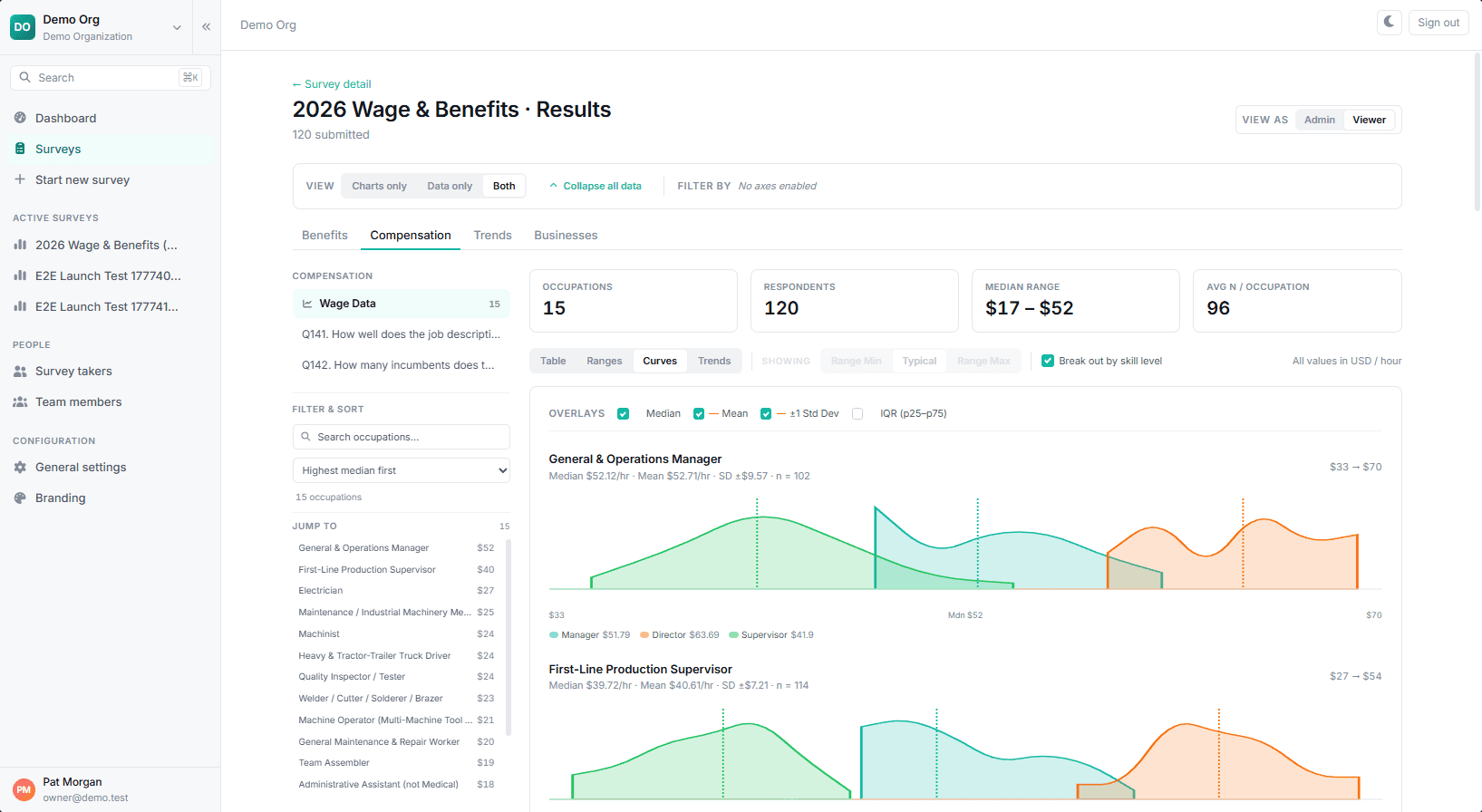
Compensation curves by occupation with median, mean, and standard-deviation overlays

Shortlisting? Put us on it properly.

A 20-minute walkthrough against your actual survey, your roles, and your region. No scripted pitch, and we will tell you if another category on this page fits you better.

Due diligence

Six questions to ask any provider

Whoever you are evaluating, including us, these are the questions that separate a benchmark you can act on from a confident-looking number.

  • Whose data is in it? Which employers, how many, which industries and geographies. If the cohort does not match the market you hire from, precision elsewhere cannot save it.
  • What is inside the number? Base only, base plus incentive, or total cash. Providers differ, and mixing definitions silently is the most common way comparisons go wrong.
  • How fresh is it, really? Ask for the effective date of the data, not the publication date of the report. Annual publications can carry figures collected many months earlier.
  • How is confidentiality enforced? A stated suppression rule protects participants and tells you the provider takes the data seriously. Ours is configurable per survey, with per-occupation cell protection.
  • Can you compare year over year? A single cycle is a snapshot. Ask whether the instrument stays stable and whether prior cycles link, because trend is what pay decisions actually need.
  • Who owns the instrument and the history? With consultants and data licenses, usually them. On our platform, you: exportable at any time, and the roster and instrument carry into next year.

Common questions

  • What is the best compensation benchmarking tool?

    Depends entirely on your market. National talent market with fast-moving rates: a real-time tool like Payscale or Pave. Large enterprise with recognized-benchmark requirements: Mercer or WTW. A county, region, or industry association that needs data on its own cohort: a convened survey, which is what Sensible Surveys is built for. The wrong-fit tool is not slightly worse; it answers a different question.

  • How much do compensation surveys cost?

    Rough shapes: DIY form tools run tens of dollars a month but leave all the compensation work to you. Syndicated data licenses commonly reach five figures. Custom consultant studies typically quote in the $20k to $80k range per cycle. Our platform is a flat $5,000 per year including three surveys, with Done-For-You quoted per survey. See pricing.

  • Should we buy survey data or run our own survey?

    Buy when the roles you benchmark trade on a national market, because someone has already collected that data well. Run your own when the market is local or industry-specific, because no one has, and the dataset you build compounds year over year instead of expiring with a subscription. Our compensation surveys guide works through the decision.

  • Can we combine multiple sources?

    Sophisticated comp teams usually do: syndicated or real-time data for nationally traded roles, a convened local survey for everything hired regionally. The one rule is to keep effective dates and definitions straight across sources, which our operational checklist covers.

  • What are the best alternatives to Mercer or Culpepper?

    Depends on what pulled you toward them. If it was recognized national benchmarks, WTW and Payscale are the like-for-like alternatives. If it was industry data, the real question is whether their panel matches your cohort; when it does not, a convened survey of your own membership beats a closer approximation of someone else’s. And if it was sticker shock, that is usually the moment to price running your own: our flat license typically costs a fraction of a syndicated cut, and the dataset it produces is yours.

  • Where do consultants fit?

    A good consultant adds judgment, change management, and a defensible outside voice, and charges accordingly. If what you need is the survey itself, a platform does that layer for a fraction of the cost. Many of the firms in that business actually run their client surveys on platforms like ours; that is what our partner program is.

Complex surveys to send and don’t know where to start?

Book a 20-minute demo. We’ll show you the system, talk through your goals, and tell you whether we’re a fit. No pressure.